The Garden
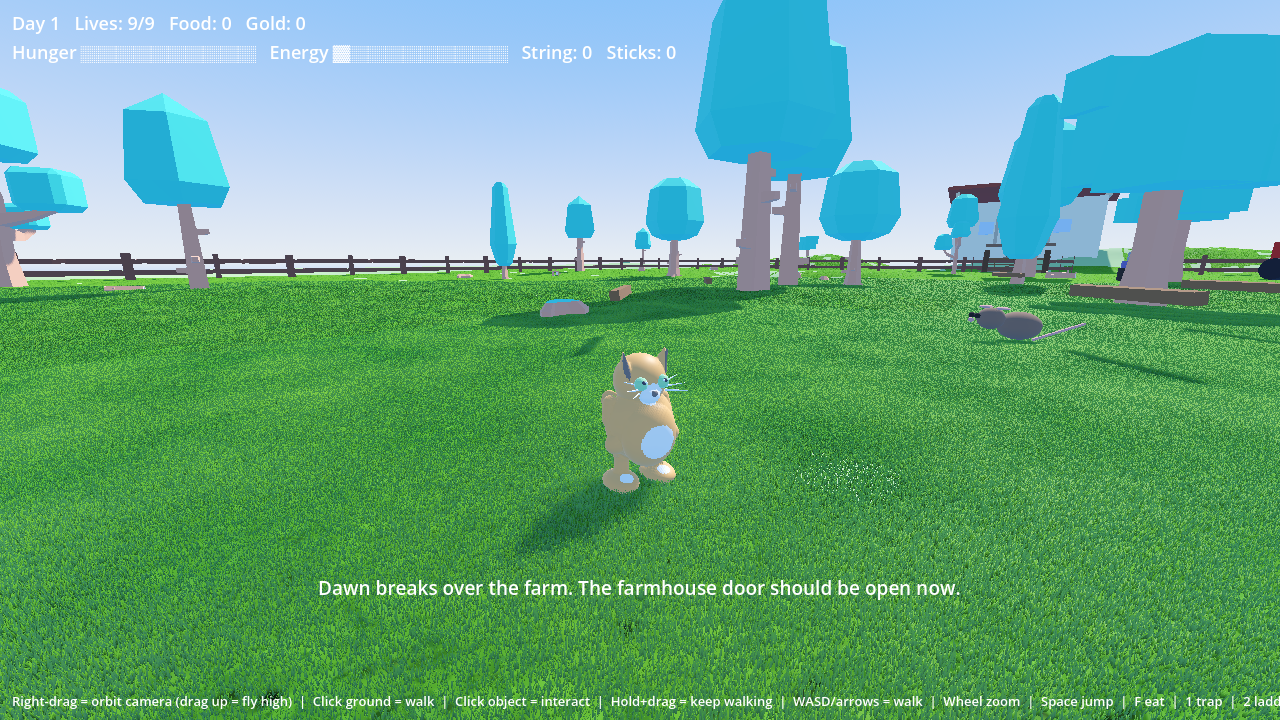
Wicked Whiskers was lost. He had no idea where he was or how he got there. He didn't even know that his name was Wicked Whiskers — but we do, because it's printed right there on the book cover. It was dusk, hunting time, and Wicked Whiskers was feeling hungry.
He surveyed his surroundings. He appeared to be in a garden. Mostly grass, but he could see trees, a lake, a shed, and in the distance a gate — and beyond that, a house. Close to the gate he could make out the silhouette of another cat. Friend or foe? He padded forward to investigate.
As he got nearer, he saw that the cat was an old fellow wearing a wizard's hat and half moon spectacles. Long white hair, long white beard, and a shiny plastic ball he was batting idly with one paw. The old cat looked at him — not aggressively, but warmly, like a kindly grandfather who had seen far too much nonsense and was prepared to see a little more.
Wicked Whiskers approached gingerly.
"Ah… young Whiskers," said the aged feline in a warm, gravelly voice. "I am Dumbleclaw, former Headmaster of Mogwarts, with nearly nine lifetimes of purr found wisdom to share. I've been playing with this ball for thirty three and a third years — that must be something of a long playing record."
He blinked at Whiskers, a slow, ancient blink that felt like a blessing.
Whiskers nodded respectfully. Dumbleclaw was a legend. Or a menace. It depended who you asked.
"Now then," Dumbleclaw continued, settling himself on a patch of sun warmed earth. "The farm. A purr fect playground of opportunity — flying twits perched in the trees, a nice fat fish would be a reel catch — though they can be a little koi, and you will want to be on squeaking terms with the mice." He paused, then added, "Hope that last pun is not too cheesy."
Whiskers smiled. The old cat still had it.
"If you dinner eat for a day," Dumbleclaw said, "you might lose a life. But if you have any spare fare, I will buy it off you for gold, which will be useful later."
Gold? Whiskers didn't know what he'd spend it on yet, but he liked the idea of being wealthy. Wealthy cats got respect. And snacks.
"You should also be able to get food from the farmhouse," Dumbleclaw added. "The farmer's wife is usually a soft touch, but they lock the house at night, so you won't be able to get in there till morning."
Wicked Whiskers thanked Dumbleclaw for his sage advice and padded back into the garden to see what he could hunt for dinner.
It didn't take long before a likely candidate presented itself. In a nearby tree, a smug looking bird stared down at Wicked Whiskers — in every sense of the word.
"Ha ha, Whiskers! You can't catch me!" taunted the flying twit.
"We'll see about that!" replied Whiskers, running at the tree and trying to climb it. But there were no low branches, and the bark was slippery. Wicked Whiskers fell down and landed on his head.
"Don't be a soar loser," said the bird, "even though this must be a hawk ward moment."
Whiskers tried again, but to no avail.
"If only I had a ladder," he thought.
A plump field mouse twitched its whiskers at him from beneath a clump of clover. Maybe this would be easier prey. Whiskers lowered himself into a crouch, tail flicking with anticipation. The mouse stared back, eyes bright, nose twitching like it was mocking him.
Whiskers lunged.
The mouse bolted.
"Prowl prowl prowl…" Whiskers muttered as he chased it, paws thudding softly against the earth. The mouse zigzagged like a tiny, furry lightning bolt. Whiskers pounced — and landed squarely on his face.
He spat out a daisy.
From somewhere below, tiny laughter echoed.
"You've got to be kitten me," he grumbled.
He needed a trap. A proper trap. Something convoluted and clever. Something worthy of a cat burglar. But he had no string. No sticks. No materials at all.
He sighed and moved on.
The pond shimmered in the fading light, its surface rippling gently. A fish swam lazily inside, its scales glinting like treasure. Whiskers dipped a paw into the water.
The fish swam away with the kind of smugness only fish possess.
"I can't reach it with a paw," Whiskers realised. "I'd just be floundering. I need a fishing rod. Which means I need string. Maybe there's some in the shed."
He sidled over to the shed and tried the door. It was padlocked with a combination lock. Another dead end.
The tractor sat nearby, silent and imposing. Whiskers approached it. Most cats were not fond of machines. Machines were loud. Machines were unpredictable. Machines did not appreciate the delicate art of napping. But Wicked Whiskers was not most cats. He admired the powerful look of the tractor — a no nonsense piece of machinery built to do not one job but countless jobs on the farm.
And it had an interesting number plate: NUM 246.
"I wonder…" thought Wicked Whiskers.
He returned to the shed and entered 246 into the padlock. The padlock sprang open with a most satisfying click. The shed door creaked open.
There was not a lot inside. A few rusty tools, dusty and abandoned since the dawn of time. But there was exactly what he had hoped for: a ball of string. Triumphantly, Wicked Whiskers put it in his rucksack — and noticed that under the string was a set of keys that might fit the tractor.
"Do you know what you're doing down there?" taunted the bird. "Or are you just winging it?"
But Wicked Whiskers had a plan.
In fact, he had two plans. He considered making a ladder out of sticks (of which there was no shortage in the field) and string, but his other plan was faster. He picked up the keys and went back to the tractor. They fitted perfectly, and the tractor started with the first turn of the key.
Wicked Whiskers put the tractor into gear and drove it towards the tree at full speed.
"You wouldn't dare!" squawked the bird.
But it became increasingly obvious that Wicked Whiskers would dare.
Seconds later he hit the tree with a bone jarring thump, which knocked the flying twit right out of its nest onto the ground. Whiskers leapt out of the tractor seat and caught his prey. I will not go into details, but shortly afterwards Wicked Whiskers had a full tummy and was happily picking feathers out of his teeth.
The mouse looked on disgustedly. Whiskers looked at the mouse.
An hour later, Wicked Whiskers had finished building the stupidest looking mouse trap you could possibly imagine. It began with a single stick — the "primary structural support," as Whiskers proudly called it — wedged upright between two stones. Balanced precariously on top of this stick was a second stick, forming a sort of seesaw that probably did not need to exist but made the whole contraption feel more scientific.
A length of string ran from the end of the seesaw to a third stick, which had been tied to a fourth stick, which had been lashed to a fifth stick, which had no purpose whatsoever except that Whiskers liked the symmetry. The string continued across the grass, looping around a stone, then another stone, then a third stone for good measure, before finally attaching to a tiny twig that Whiskers referred to as "the trigger mechanism."
The trigger mechanism was connected — via yet more string — to a suspended basket made entirely of sticks and string woven together with painstaking effort. The basket hung from a branch at a height that suggested Whiskers had briefly forgotten how tall mice were. Beneath the basket sat a tasty morsel of human food. In fact, it was a small piece of the main ingredient of a cheese sandwich.
The theory was this: The mouse would approach the scrap. Its weight — even the tiniest nibble — would disturb the twig. The twig would twitch, pulling the string. The string would yank the seesaw. The seesaw would tilt, dropping the stone tied to its end. The falling stone would tug the long string running across the grass. That string would pull the basket's support stick out of place. The basket would fall. The mouse would be trapped. Whiskers would celebrate his engineering triumph.
The mouse had been watching this construction, off and on, and had reasonably concluded that this machine had as much chance of flying to the moon as it did of performing its intended function. It strolled up to the cheese and took a bite.
It certainly did not anticipate what happened next.
The mouse's nibble disturbed the twig. The twig twitched, pulling the string. The string yanked the seesaw. The seesaw tilted, dropping the stone tied to its end. The falling stone tugged the long string running across the grass. That string pulled the basket's support stick out of place. The basket fell, trapping the mouse.
Whiskers sprang over and caught the mouse (still in the basket), tying it up securely with string and celebrating his engineering triumph.
"Who'd have thought it?" he said proudly. "Two down, one to go."
You do not have to be an engineering genius (or incredibly lucky) to build a fishing rod. What you need is a stick, some string, and a hook. Whiskers returned to the shed to see if he could find anything that would do as a hook — an old nail, a staple, a paperclip or safety pin. In fact, he found both a bent nail and a staple. The nail looked like the sturdier option.
Whiskers returned to the pond. He scratched a hole in the ground and dug up a nice big juicy worm, which he attached to the hook. He cast his rod and reeled in the flippant fish.
"Three out of three, and that's oFISHial," he declared proudly.
Wicked Whiskers sauntered over to Dumbleclaw, tail high.
"You've caught them all, Whiskers!" Dumbleclaw said, eyes gleaming. "Mouse, bird AND fish. I always said you had the makings of a legend. You say you have eaten one — I suggest you keep the fish as an emergency snack and sell me the mouse. There is more food in the house, which should be opening about now."
Whiskers agreed to Dumbleclaw's suggestion and handed over the trussed up mouse, receiving one gold piece in return.
Down the path he could see lights turning on in the main farmhouse.
"Purr fect timing," he thought, and saying goodbye to Dumbleclaw, he walked down the path to the farmhouse.
The Farmhouse
Whiskers padded up the path to the back door of the house. He could see the kitchen and the farmer's wife. He could smell freshly baked bread, coffee, and dog. Dumbleclaw had not warned him about any dogs. Hopefully this one was harmless and things were not going to get ruff.
He crept up to the door, which was open just a crack. Whiskers flicked out a claw and used it to open the door a few paw-cent more, not much more than a whisker. He could see the dog now; it was a large white Labrador. No cause for concern there. Labradors were generally too lazy and preoccupied about where their next meal was coming from than they were in chasing cats. This one was lying in its bed watching the farmer's wife baking the bread that smelt so good.
"That dog has the right idea," thought Whiskers. "She makes the bread and he does the loafing."
Whiskers opened the door enough to poke his head in and deployed one of his secret weapons: a deeply plaintive, heart-wrenching meow. The meow of a cat that had not eaten for a week (and certainly didn't have a tasty fish in his backpack).
The farmer's wife stopped kneading the dough, her expression softening instantly. "Well, aren't you a hungry little fellow?" she cooed. She quickly abandoned her baking and poured out a saucer of fresh, creamy milk, setting it down with a gentle smile.
Whiskers lapped the milk up eagerly, it was udderly delicious.
The farmer's wife returned to her baking, so when he had finished his milk, Wicked Whiskers decided to investigate the rest of the house. Across from him, right next to the chilling canine, a door stood half-open. Keeping a cautious eye on the bone-idle beast, Whiskers nudged the door wider to see where it would lead.
Whiskers nudged open the door and stepped into the living room and immediately realised he had struck gold — quite literally — in the form of a plump goldfish swimming round in a bowl on top of a rickety looking table. It was an easy leap onto the table and the only thing separating the fish from Wicked Whiskers was the bowl. Unfortunately, the bowl had a lid on it that Whiskers could not pry off.
"Maybe," thought Whiskers, "if I pushed the entire table over, the bowl would smash and the fish would be a fin-tastic supper," but he could not push it over.
He was looking around the room for something to help him and his eyes fell upon the farmer's wife's sewing kit, lying on the couch. He rummaged through it and found a ball of wool. Not much use for the present problem, but wool was fun. He threw the ball in the air and it started to unravel. This gave Wicked Whiskers an idea. By most standards this was not a particularly good idea. Quite the opposite in fact, but a one-in-a-million chance was better than no chance at all. He found some ribbon in the sewing box and used it to tie the wool onto the top of his head with a bow and padded back into the kitchen.
"Ohh, who's this?" asked the farmer's wife. "You look a bit like the cat I fed earlier, but you have a lovely ribbon in your hair. Would you like some milk as well?"
"How stupid these humans are" thought Wicked Whiskers "Which is very fur-tunate for me". Giving out another plaintive meow he was soon lapping away at his second bowl of milk of the morning.
The farmer's wife got back to her work and got a large breadknife out of one of the drawers, using it to make a sandwich.
"That breadknife looks a bit like a saw," thought Wicked Whiskers. "I wonder…"
The farmer's wife replaced the knife in the drawer and left the kitchen to go and give the sandwich to her husband, leaving the coast clear. Whiskers jumped onto the countertop to see if he could open the drawer from the top, but it soon became clear that this was not going to work. He jumped down again and saw that the dog's basket was not far from the drawer. If he could move that, then maybe he could stand on the dog and open the drawer like that. He put his back against the dog basket, but it was too heavy.
"Move, you mutt-ton head!" shouted Wicked Whiskers, but the dog showed no signs of wanting to comply.
Whiskers jumped back on the counter, weighed up the distances, took a run-up, and launched himself into the air, claws fully extended, landing squarely on the dog, who let out a yelp and leapt out of his bed. Whiskers quickly pushed the bed under the drawer and waited for the lazy Labrador to forget all about the attack and return to his bed — which didn't take long, Wicked Whiskers was then able to stand on the dog, pull the drawer out, and the breadknife was his.
Triumphantly, he took his prize to the living room and used this cutting edge technology to saw away at one of the legs of the table.
It took some work, but eventually he sawed through the leg, scampering out of the way as the table came crashing to the floor. As the goldfish bowl hit the ground, its lid came off and water went everywhere. Whiskers grabbed the fish and put it in his rucksack with the other one. Moments later, the farmer's wife came storming into the living room.
"What's this racket?" she demanded.
Wicked Whiskers put on his most innocent expression, but even something as dim-witted as a human was not going to be fooled by that.
"You wicked cat!" screamed the farmer's wife, aiming a boot at Wicked Whiskers, who took the attempted assault as evidence that he had out strayed his welcome. He hopped onto the window ledge and out of the open window, down the drive and out into the big bad world.
Into Town
Wicked Whiskers departed the farm at precisely the kind of hour when fences still yawn, cockerels check their watches, and farm boundaries are too sleepy to file official complaints. He crossed the meadow with the dignity of a cat who knows his tail is on trend and his whiskers are likely to be in the next village paper. The village smelled of fresh bread, old gossip, and the very faint possibility of trouble — which, to a cat, smelled a lot like dinner — and dinner, for Whiskers, smelled dangerously like destiny.
He had two fish in his rucksack, a belly full of milk, and absolutely no idea where he was going. This was, by his standards, a very good start to the day.
The lane curved gently downhill, away from the farm and toward a cluster of buildings that Whiskers could only describe as "a town, but with fewer pigeons and significantly more attitude." The high street featured a bakery, a butcher, a fishmonger with a punny sign, and a pub called The Salty Cod. The post office was run by a woman who looked like she'd rather be anywhere else — preferably underwater. Pigeons strutted around the square like they owned the place. A dog slept in a doorway. A human carried a bag of shopping and didn't notice Whiskers at all, which was exactly how Whiskers preferred it.
He trotted down the high street, tail high, fish securely fastened in his rucksack, feeling rather pleased with himself. He had survived a farm, outsmarted a padlock, caught three animals, and escaped a farmer's wife armed with nothing but a boot and a loud voice. A village should be a doddle.
He was busy admiring his own reflection in a shop window when the seagull arrived.
It materialized like a feathered ninja, descending from the clouds with all the subtlety of a pigeon in a china shop — which, come to think of it, is exactly what seagulls are: pigeons with anger management issues and a stolen credit card. It was enormous. It was white. It had a beak like a can opener and the moral compass of a pickpocket.
Whiskers heard the wingbeats a fraction too late. He looked up just in time to see the seagull swoop down, grab one of the fish from his open rucksack with the casual expertise of a professional thief, and flap away with it dangling from its beak like a wet trophy.
"Oi!" shouted Whiskers.
The seagull didn't even look back. It just kept flying, the fish swinging beneath it like a pendulum of betrayal.
"You bird-brained feather duster!" screamed Whiskers. "That's fin-acceptable! I'm getting that fish back if it's the last thing I do. Well, the last thing I do in this life, anyway — but you get the idea!"
The seagull landed on a lamppost, twenty feet up, and began to eat the fish with the slow, deliberate smugness of a creature that knew it was out of reach. High-altitude highway robbery.
Whiskers stared up at it. The seagull stared down at him. It flicked a fish bone in his direction with the precision of a tiny assassin. It landed on his head, slid down his nose, and wedged itself perfectly between his ears like a tiny, insulting crown.
"Oh, it is ON," said Whiskers.
He looked around for something to help. A drainpipe — too slippery. A bin — too full. A bicycle — too confusing. Then he spotted it: a clothesline strung between two buildings, hung with tea towels and sheets, waving gently in the breeze.
Whiskers had an idea. It was not, by any reasonable standard, a good idea. But Wicked Whiskers had never let that stop him before.
He ran at the wall, leapt onto a window ledge, scrambled up a drainpipe (it was marginally less slippery than it looked), and launched himself onto the clothesline. The line snapped taut, then sagged dramatically. He grabbed a tea towel — a lovely floral one that screamed "I sold jam at the village fair in 1987" — and swung like a furry pendulum, knocking a potted geranium off a windowsill. It exploded below in a shower of soil and indignation. He found himself hanging upside down directly above the lamppost, looking absolutely ridiculous.
The seagull looked up. Its expression changed from smug to "oh-this-is-actually-going-to-hurt" in approximately half a second, which was still half a second too late.
"Surprise," said Whiskers, dangling upside down with a tea towel wrapped around one leg, a geranium leaf stuck to his nose, and the absolute conviction that he'd nailed this. "I'm so sorry to drop in unannounced."
He let go.
He landed squarely on the seagull. The bird squawked, flapped, and dropped the fish. Whiskers caught it in mid-air — one paw, clean catch, like a furry outfielder — and rolled off the lamppost, hit the pavement, bounced, and came to rest in a flowerbed.
The seagull flew away, screaming insults in what Whiskers assumed was seagull for "I will be filing a formal complaint."
Whiskers lay in the flowerbed for a moment, fish clutched to his chest, covered in petals and the quiet satisfaction of a job well done. Then he stood up, shook himself off, and tucked the fish back into his rucksack. Two fish. Right where they belonged. The seagull had eaten nothing but air and regret.
"Right," he said. "Now I need breakfast. Proper breakfast. The kind humans eat."
The butcher's shop was right there. A string of sausages hung in the window, glistening like jewels. A joint of chicken sat on the counter, pink and promising. The butcher was inside, serving a customer, his back turned.
Whiskers slipped through the open door. The chicken gleamed on the counter like an edible crown jewel. It smelled like the best thing he'd ever smelled — assuming "best thing" meant "reason to commit grand theft poultry." Which, it did.
He leapt onto the counter, grabbed the chicken in his teeth —
"HEY!" shouted the butcher.
Whiskers bolted. He shot out of the shop like a furry cannonball, chicken in mouth. Behind him, the butcher roared, the customer shrieked, and a rack of pork chops fell like meaty confetti. He dodged a pram, leapt over a dog, slid under a bench, and ricocheted off a lamppost. The butcher gave up after half a block, wheezing about "that blasted cat" and a "four-alarm feline felony." When a bystander asked what had happened, the butcher gasped, "Poultry larceny! By air mail!"
Whiskers hid behind a wheelie bin, panting, chicken still clamped in his jaws. He was alive. He was victorious. He was a criminal.
He ate the chicken behind the bin. It was delicious. It was worth every frantic step. He licked his whiskers, burped quietly, and thought about what to do next. He still had two fish in his rucksack — one for eating, one for trading. Dumbleclaw had said gold would be useful, and a fish was worth its weight in gold to the right buyer.
He noticed a discarded newspaper beside the bin. He didn't care about newspapers — until a headline caught his eye: PIED PIPER'S PIPE HYPE NOT TRIPE. He read the article. The Pied Piper's Pipe of Muminpur — an ancient relic that attracted rats — had been found and was on display at the City Museum. WW stared at the headline. His tail flicked. "If that pipe can call every rat in the city... I could run this whole place."
That was when a woman found him.
She was not angry. She was not cross. She was the sort of woman who treated her handbag like a feline vending machine — always stocked, always ready, emergency tuna budgeted in at all times. She had names for all the local cats (even the ones that actively avoided her) and the superpower of seeing any filthy cat and thinking "what a precious angel." She knelt down, saw Whiskers sitting there with chicken grease on his whiskers and a flower petal on his ear, and her face melted like butter on a warm scone left out in July.
"Oh, you poor thing," she cooed. "You look half starved. Here, have a bit of this."
She produced a tin of tuna from her handbag and opened it on the spot. Whiskers ate it without dignity. He knew exactly what he was doing — the plaintive eyes, the tucked-in paws, the slight head tilt. He was a professional. Tuna from a tin was not the same as a fresh fish, but it was food — free food at that — and Wicked Whiskers was far too proud to turn it down.
"You're a handsome one," the woman said, scratching him behind the ears. "Very wicked looking. I shall call you Wicked."
"I have a reputation, actually," Whiskers thought, though he purred anyway because the scratching was very good.
He thanked the woman (with a meow, which she interpreted as gratitude), wiped the tuna from his whiskers, and padded back into the square. The sun was warm. The pigeons had moved on. The seagull was nowhere to be seen. And Whiskers had two fish, a belly full of chicken and tuna, and the distinct feeling that this village was going to be very interesting indeed.
He looked at the pub, the post office, and the lane leading to whatever came next. "I think I'll stay," he purred to the empty square. "This village is chaotic. It's perfect. It's basically my autobiography waiting to happen."
He caught the scent of fish fry drifting from The Salty Cod and grinned. "And I've only just started."